Showing posts with label siem reap. Show all posts

Tuesday, April 29, 2014

Up!

The new school is starting to take shape! The pillars are in place so now just to add some bricks and a roof.

Good to see the weekly progress - more photos in a week.
Metal mesh cages to create the concrete pillars are a common sight

Cambodian building work at it's finest.

We've gone for a natural floor effect, that massages your feet as you walk!

Friday, March 21, 2014

The school building begins...

A long time ago in November, we applied for planning permission from the Apsara Authority to build a small school in a village where we do a lot of well installation.

On Monday we finally received written approval, and so on Thursday we held a land blessing ceremony and got some materials on site to start building!

Thanks for everyone who has donated and been so patient. We will use this page to update you and maybe get some video soon.

Sand, stone and rocks!

The planner figuring out the plans

The Apsara representative checking we do have permission!!

Scaffolding and other bits and bobs needed

Tuesday, February 25, 2014

Meet a teacher - Noeurng Nak


Hello! My name is Nak. I am 25 years old and I come from Banteay Meanchey Province.

I have lived in Siem Reap for 4 years, and I have been teaching at FKC School for 6 months. I teach the Beginner class. In the evenings I am an English and Teaching student at Build Bright University, currently studying in my fourth year.

In my free time I like to read, watch the news, and spend time with my family. I also like going to Baray Lake.

In the future, I still want to be an English Teacher and live in Siem Reap. I hope to gain a lot of experience at FKC to improve my teaching methods, as well as learning more at university.

Interested in sponsoring one of teachers? Click here

Wednesday, February 19, 2014

Redecorating the school

With over 300 children running and playing and studying at the school each day, some things get a bit worn down, and we're not just talking about the teachers!

The school buildings have to put up with 600 hands and sometimes feet, as well as the extreme weather we get over here, from high temperatures to heavy rain and winds.

Every year in January we redecorate the school and clean around the grounds, giving it a lick of paint and patching up any holes we find! January is the perfect time as there is no rain, the temperature is fairly mild and we have a number of volunteers who come with David.


Monday, February 10, 2014

Students' health and wellbeing

For many families in Cambodia, eating a balanced diet that provides everything their body needs can be a challenge. Rice is the staple food here, and if families can afford to, they will make fish and vegetable soups or side dishes on top. Still, these dishes might not be sufficient and therefore quite often people go without the vitamins and nutrients they need to improve their health.

In order to help our students grow up to be healthy and strong, we provide vitamin drinks or pills whenever we have them in stock, which unfortunately is not as often as we would like. If you would like to help us provide them more consistently, please visit www.khmerchild.org/donations and get in touch.

The teachers discussing what the drinks are.
Preparing the vitamin drinks, they came in a number of flavours
But not all kids thought they tasted as they thought!

Monday, January 20, 2014

Thank you Lynbrook Primary!

Recently we had the fantastic Teachers Donna and Laura here, sent all the way from Australia, to help train our teachers in teaching phonices and class management.

In the week they were here they imparted so much of their knowledge, leaving our teachers confident, wiser and happier.

They also sent us some great resources including phonic cards, posters, teachers guide and Youtube videos.

It wasn't just the teachers who got a treat - all our students were made a bookmark by the students from Lynbrook - so thank you all for your great gifts and check out the photos below!

The kids studying the excellent drawings on the bookmarks

Our Beginner Class holding up the gifts proudly - Thanks!

Monday, January 13, 2014

Medical care for the community

On the 4th January we were visited by an American Doctor Mission to provide health education, student check-up and paint many faces. In fact it seemed the face painting was far more popular than seeing the Doctors for some reason!

After the mission had ended, the Doctors left us small first aid packs to distribute to the families in villages where we work and to distribute the vitamin tables for children.


Vitamin tables and vitamin drinks were also
left to give to our students regularly
Plasters, medication, antiseptic creams and
much more were left for us to distribute


Monday, December 30, 2013

Dreams of the future


Rathana works as a senior supervisor at a restaurant in central Siem Reap. Everyday, he attends the advanced English class at FKC from 10 to 11am. At 30 years old, Rathana is nearly twice as old as the other students in class, but he still comes to school because he wants to be a hotel manager in the future. Nearly half the class wants to work in tourism. A few aspire to open their own restaurant or a hotel in future.

SiemReap’s main economic activity is centred on its national heritage, Angkor Wat. The city’s reputation as a tourist-friendly destination means that there will never be a shortage of jobs as barmen, tour guides, drivers, receptionists, shop assistants, waiters, and chambermaids. Many want to work in hospitality because it offers job stability and best of all, it brings in a relatively good income.

But just as Siem Reap is more than its ancient history, so is its youth more than just aspiring cooks. The problem is not so much a dismal lack of ambition, as is a lack of imagination of the options beyond the tourist dollar.
 
          It all starts with an education


In Cambodia,a typical child attends a government school either in the morning (7..30-10.30am) or afternoon (1.30-4.30pm). In other words, he studies for only half a day up till high school, taking subjects such as Math, Science and Khmer. English only just been made compulsory from Grade 6 upwards.

The child is free for the rest of the day unless—and if family circumstances permit—he attends English classes run by the private and non-profit sectors. FKC is one such charity that provides free English lessons for students aged between two and 30.

The country’s lack of emphasis on education accounts for the short amount of time students spend in a state school. Only 10-15% of the national budget is set aside for education, resulting in a gross shortage of teachers and teaching resources. Teachers also earn low salaries, an average wage of $80 a month.

It is for this reason that NGO schools play a very significant role in Cambodia’s education system. These schools not only provide a child a safe environment to play and learn in, it also helps him gain a foothold for the future, should he wish to pursue a university education.

English, in particular, is an important subject as it opens up an infinite world of imagination for the young. Considering how much information on the Internet is in English, proficiency in the language would therefore give one access to a wide variety of topics. Information breeds knowledge, and knowledge, curiosity. It all starts with an education.

Thinking big, achieving dreams

Unfortunately, many children drop out of school even before they can think about university and beyond, because main bread and butter issues prevent them from completing their basic education. Those fortunate enough to finish high school often take up an apprenticeship or vocational studies where they learn how to cook, clean or sew. Few go to university, and even fewer are those who secure a place in a foreign university. Very rarely do students in Siem Reap become doctors, lawyers, accountants or nurses.

But students in the advanced class do dream of doing something different from their peers.Channa, for instance, wants to be an accountant, and Kakada, a doctor. Three other students want to be teachers.

There is nothing wrong in wanting to work in hospitality, after all, it is a respectable job that earns an honest day’s living. Rather, students need to be stretched mentally and be encouraged to think beyond their geographical limits. Young people have a lot of potential and they can be so much more. It is our job as educators to make them realise it. 

- Zhuomin Lee


Saturday, December 28, 2013

Points of View II: Zhuomin Lee, Singapore


This time Zhuomin shares us with us her joys (and frustrations) of teaching English!

"Is it appropriate to express mild frustration about students who just don’t get it? If you are a teacher by profession, this will sound familiar.


Last week students in the intermediate class learnt about clothes, which was fun when it came to role play. They took turns pretending to be customers and shop assistants in a store asking about prices and sizes. This was also a good opportunity to review numbers above one hundred, a lesson they had previously learnt.


This afternoon we went through the same sentence structure again and they made the same grammar mistakes as they did last week. Some also had problems remembering that trousers, shorts and shoes come in pairs.


“I would like to buy a sue.”


“I would like to buy a pair of shoes.”


“It costs 20 dollar.”

“It costs 20 dollarssssss.”


The s sound exists in Khmer, as in Siem Reap and Banteay Srey. However, it is not pronounced if it is at the end of a word. This is why they often miss out the audible s at the end of a plural noun.


“Guys! Remember the s!”. Hiss.


But teachers make mistakes too, and half the time we don’t have the answers either. For example, articles (a, an, a pair of) are hard to remember, even harder still to explain. Two similar items make a pair, so why is it ‘a bikini’ and not ‘a pair of bikini’?


Some grammar rules are as such because… they just are. It sounds correct and it makes sense because we have read, conversed, written, and taken exams in English all our lives, but for individuals who do so in another language, they naturally struggle. In other words, it is like trying to study Khmer from scratch and be expected to do well in four weeks!


The classroom is the only time students get to use their English language skills, since they speak Khmer at home and with their friends. Yet, two hours of practice a day is hardly enough. Although there is a lot of catching up to do, force feeding and setting them challenges way beyond their abilities is not the way to go. As it is, some students have problems attending school. The worst thing to happen is for them to quit school all together, not because of their socio-economic circumstances but because they have completely lost interest in learning.


For the rest of this week, some of us shall probably have to continue to eat, sleep and dream a pair of shoes until the children get it right."

Saturday, December 21, 2013

A new well for the village


Kok Thnoat village is about a 30-minute drive away from central Siem Reap. Past the airport and the ancient temple ruins of Bayon, the road leading up to the village is a small pot-holed dirt path, and becomes narrower until no four-wheeled vehicle can pass. The rest of the journey has to be done either on foot or on a bicycle.

Children swing in a hammock. They
belong to one of the few families
who will benefit from the fresh water
supply.
Four year old SreySa (left) and her sister
Srey Chit, 6,sit on the steps of their home.  


On one of our recent visits, a new well was being dug. When finished in a couple of days, this well will be a safe and reliable supply of drinking water shared between four families. Other areas have also been earmarked for new wells, and it is our hope that every family will have their very own water source one day.

A construction worker digs a well with basic
tools. A typical well is between 25 and 30
metres deep and can take up to a week
to complete

A family holds up a well
sign. They will finally
have fresh water indoors
when the pump is ready.


The entire village used to share a derelict public well until some families decided to dig their own in their backyard. At 3m deep, these are unfortunately no more than muddy ditches that breed micro-organisms and algae. They are also a potential drowning hazard for small children.

It gets worse during the rainy season between September and November, when the whole village goes underwater, temporarily suspending all access to drinking water. At one home visit, workers were putting the finishing touches to a new water pump. When completed, it will be connected directly to the house so that the family will have a constant supply of fresh water even during the rainy season.
  
Longbean, morning glory and
pumpkin seeds being distributed.

 Once in a while, when we go around the surrounding villages to see how people are doing, we also 
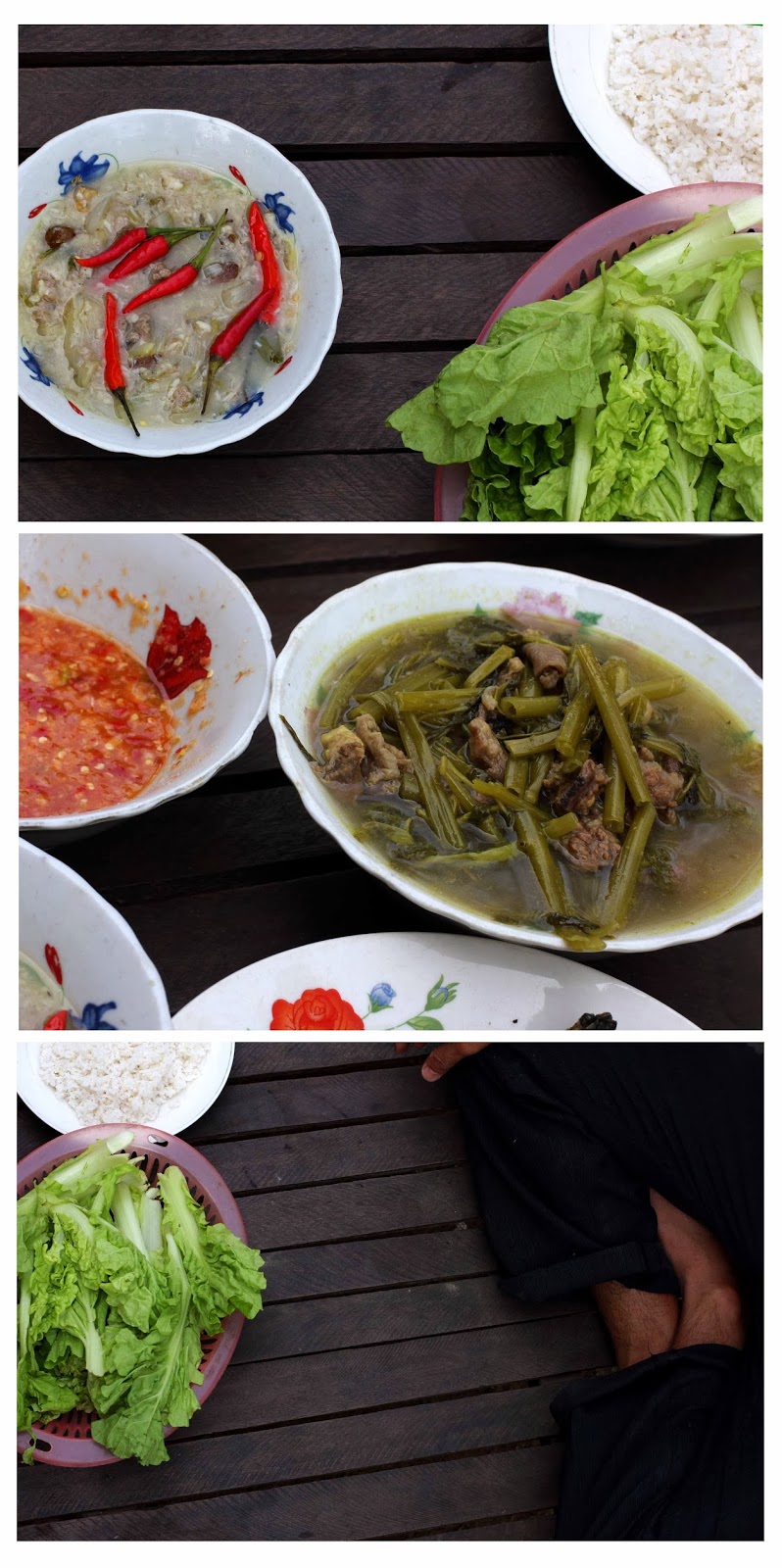
Lunch from above! Stir fried
tamarind and cabbage, beef
with morning glory and fresh
lettuce leaves
distribute vegetable seeds to help families make a sustainable livelihood. 

Life here is simple and basic—most men work in the town, while their wives look after the home, and children go to a nearby school. But it can sometimes get financially very difficult when the only breadwinner of the family becomes unemployed. 

For others, their only asset is the house they live in, built by their ancestors and passed down through the generations. There is also no electricity in the village. Despite busloads of tourists who visit Angkor Wat every year, local incomes and standards of living have not gone up. As a result, Siem Reap continues to remain one of the poorest provinces in Cambodia.

Beyond the poverty of rural Siem Reap, lies beauty in the form of a welcoming smile and a kind word for the visitor. Sometimes a meal is also generously provided, as it was for us as we happened to be there during lunchtime. This warm hospitality is definitely one of the best experiences in life.

Do visit our donations page, if you would like to make a contribution for a new well. Full-day village tours are also available here. All proceeds from the tour goes towards FKC.


It costs $300 for a well and here FKC
staff show the sign that will placed
at the site

Wednesday, December 18, 2013

Staff lunchtime

As you may know, in Cambodia there are two teaching shifts. One from 7.30 until 11, and another from 1.30 until 4. The children are different in both shifts so we end up teaching the same lesson twice! This helps us perfect our lesson plan if need be, but it sure is hard work!

Fortunately we have a couple of amazing cooks at the school - the main ones are Theavy (sewing assistant), Vatana (sewing assistant), Kanha (Deputy Head of Ed and English Teacher and Om Srey(Cook, cleaner, tuck shop lady!).

Most days, we enjoy a large bowl of rice with a soup and a vegetable dish. All locally produced and usually bought in the same village as the school. Most importantly - it is nutritious and delicious, giving us the energy needed for our second class!
Kanha cutting up the vegetables for lunch

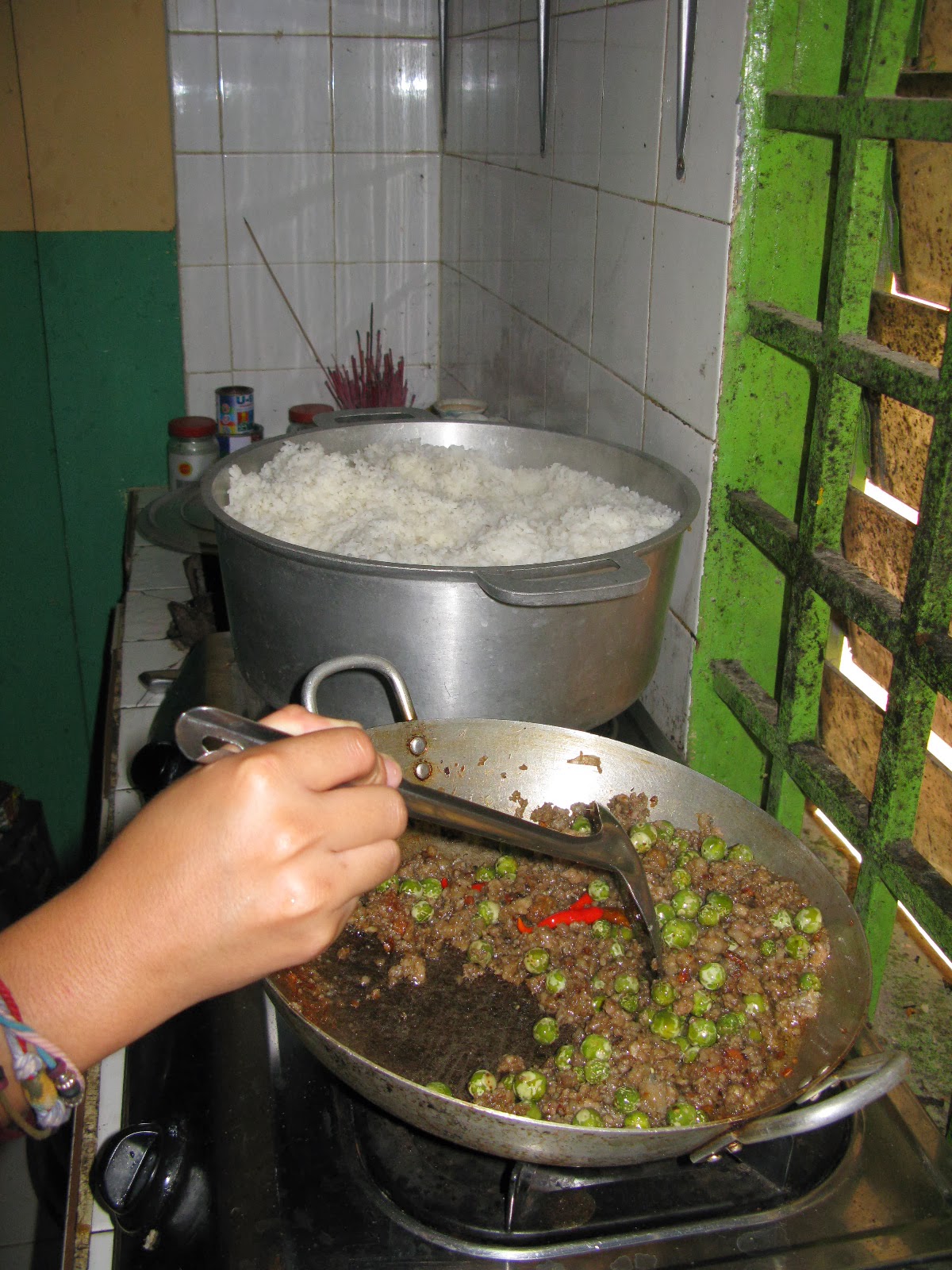
A special Cambodian dish made from peas, beef
and a variety of spices


Our cook is always able to knock up
something tasty and filling!

Tuesday, December 17, 2013

Points of View: Zhuomin Lee, Singapore

Zhuomin joined us last week for three weeks volunteering. We asked her what stood out most to here at the school and she kindly wrote all about it:

"Classroom teaching in Cambodia is a bit of a cultural shock. I don’t mean the part about kids taking lessons in a large shed or outside on the porch. No, I mean the part about them having a sincere respect for their teachers.

Every morning, I receive so much love from an enthusiastic chorus of  “Good morning teacher! How are you today?” It takes all the pre-caffeinated morning grumps away and with little effort, I find myself responding with a “I am fine. Thank you very much. And how are you today?”

“I am fine! Thank you very much!”

The dialogue goes on for a bit sometimes, depending on how much a teacher wants to practise English conversation. Otherwise, the students remain standing until they are told to sit down. And for that, they do a “thank you teacher!”

If someone wants to go to the bathroom, he/she asks for permission to leave the classroom. When he/she comes back, he asks for permission again, to go back to his seat.

Additionally, while teachers can keep their shoes on in class, students are required to remove theirs before entering a classroom. To me, it is a symbolic sign of respect for the institution and the values it embraces, though I cannot verify this, since removing footwear before entering a house is a common practice in Southeast Asia.

It is hard to not be impressed by their manners, considering I wasn’t the most respectful student back in those days. Primary school was a long time ago, but even then, I definitely did not greet my teachers with such enthusiasm. In fact, my manners got worse by the time I was a teenager. Fast forward to the present, some of my friends who are teachers back home in Singapore bemoan unmotivated students who have absolutely no interest in class. A handful has been sent to detention for defiance. No doubt juvenile delinquency is a universal problem in developed and developing countries alike, but at FKC, the students sure know how to respect an education."