Showing posts with label child. Show all posts

Tuesday, February 25, 2014

Meet a teacher - Noeurng Nak


Hello! My name is Nak. I am 25 years old and I come from Banteay Meanchey Province.

I have lived in Siem Reap for 4 years, and I have been teaching at FKC School for 6 months. I teach the Beginner class. In the evenings I am an English and Teaching student at Build Bright University, currently studying in my fourth year.

In my free time I like to read, watch the news, and spend time with my family. I also like going to Baray Lake.

In the future, I still want to be an English Teacher and live in Siem Reap. I hope to gain a lot of experience at FKC to improve my teaching methods, as well as learning more at university.

Interested in sponsoring one of teachers? Click here

Wednesday, February 19, 2014

Redecorating the school

With over 300 children running and playing and studying at the school each day, some things get a bit worn down, and we're not just talking about the teachers!

The school buildings have to put up with 600 hands and sometimes feet, as well as the extreme weather we get over here, from high temperatures to heavy rain and winds.

Every year in January we redecorate the school and clean around the grounds, giving it a lick of paint and patching up any holes we find! January is the perfect time as there is no rain, the temperature is fairly mild and we have a number of volunteers who come with David.


Thursday, February 6, 2014

Graduation Ceremony

Our school year runs from January to December, meaning that our graduation ceremony takes place at the end of January each year to coincide with one of our donors visits to Cambodia.

The top three students in each class are presented with a certificate of achievement, and all IT students also receive their final marks so they are ready to move onto the next level.

It is a fun celebration of the previous year, so naturally we have a dance, some food and lots of music!

The students showing off their certificates.

Our dancers putting on a great show!

The kids tucking in after a long morning!


Saturday, December 28, 2013

Points of View II: Zhuomin Lee, Singapore


This time Zhuomin shares us with us her joys (and frustrations) of teaching English!

"Is it appropriate to express mild frustration about students who just don’t get it? If you are a teacher by profession, this will sound familiar.


Last week students in the intermediate class learnt about clothes, which was fun when it came to role play. They took turns pretending to be customers and shop assistants in a store asking about prices and sizes. This was also a good opportunity to review numbers above one hundred, a lesson they had previously learnt.


This afternoon we went through the same sentence structure again and they made the same grammar mistakes as they did last week. Some also had problems remembering that trousers, shorts and shoes come in pairs.


“I would like to buy a sue.”


“I would like to buy a pair of shoes.”


“It costs 20 dollar.”

“It costs 20 dollarssssss.”


The s sound exists in Khmer, as in Siem Reap and Banteay Srey. However, it is not pronounced if it is at the end of a word. This is why they often miss out the audible s at the end of a plural noun.


“Guys! Remember the s!”. Hiss.


But teachers make mistakes too, and half the time we don’t have the answers either. For example, articles (a, an, a pair of) are hard to remember, even harder still to explain. Two similar items make a pair, so why is it ‘a bikini’ and not ‘a pair of bikini’?


Some grammar rules are as such because… they just are. It sounds correct and it makes sense because we have read, conversed, written, and taken exams in English all our lives, but for individuals who do so in another language, they naturally struggle. In other words, it is like trying to study Khmer from scratch and be expected to do well in four weeks!


The classroom is the only time students get to use their English language skills, since they speak Khmer at home and with their friends. Yet, two hours of practice a day is hardly enough. Although there is a lot of catching up to do, force feeding and setting them challenges way beyond their abilities is not the way to go. As it is, some students have problems attending school. The worst thing to happen is for them to quit school all together, not because of their socio-economic circumstances but because they have completely lost interest in learning.


For the rest of this week, some of us shall probably have to continue to eat, sleep and dream a pair of shoes until the children get it right."

Saturday, December 21, 2013

A new well for the village


Kok Thnoat village is about a 30-minute drive away from central Siem Reap. Past the airport and the ancient temple ruins of Bayon, the road leading up to the village is a small pot-holed dirt path, and becomes narrower until no four-wheeled vehicle can pass. The rest of the journey has to be done either on foot or on a bicycle.

Children swing in a hammock. They
belong to one of the few families
who will benefit from the fresh water
supply.
Four year old SreySa (left) and her sister
Srey Chit, 6,sit on the steps of their home.  


On one of our recent visits, a new well was being dug. When finished in a couple of days, this well will be a safe and reliable supply of drinking water shared between four families. Other areas have also been earmarked for new wells, and it is our hope that every family will have their very own water source one day.

A construction worker digs a well with basic
tools. A typical well is between 25 and 30
metres deep and can take up to a week
to complete

A family holds up a well
sign. They will finally
have fresh water indoors
when the pump is ready.


The entire village used to share a derelict public well until some families decided to dig their own in their backyard. At 3m deep, these are unfortunately no more than muddy ditches that breed micro-organisms and algae. They are also a potential drowning hazard for small children.

It gets worse during the rainy season between September and November, when the whole village goes underwater, temporarily suspending all access to drinking water. At one home visit, workers were putting the finishing touches to a new water pump. When completed, it will be connected directly to the house so that the family will have a constant supply of fresh water even during the rainy season.
  
Longbean, morning glory and
pumpkin seeds being distributed.

 Once in a while, when we go around the surrounding villages to see how people are doing, we also 
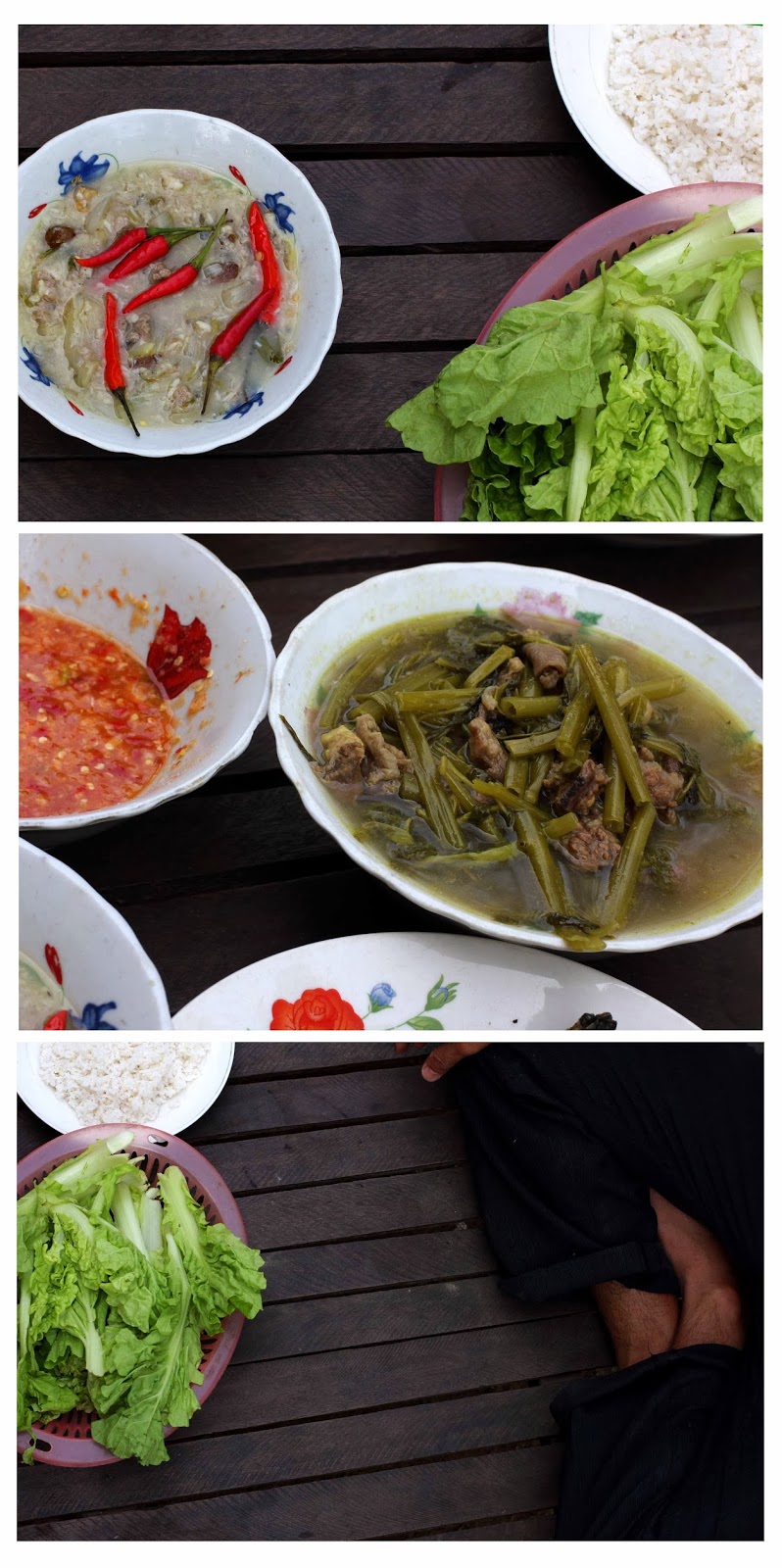
Lunch from above! Stir fried
tamarind and cabbage, beef
with morning glory and fresh
lettuce leaves
distribute vegetable seeds to help families make a sustainable livelihood. 

Life here is simple and basic—most men work in the town, while their wives look after the home, and children go to a nearby school. But it can sometimes get financially very difficult when the only breadwinner of the family becomes unemployed. 

For others, their only asset is the house they live in, built by their ancestors and passed down through the generations. There is also no electricity in the village. Despite busloads of tourists who visit Angkor Wat every year, local incomes and standards of living have not gone up. As a result, Siem Reap continues to remain one of the poorest provinces in Cambodia.

Beyond the poverty of rural Siem Reap, lies beauty in the form of a welcoming smile and a kind word for the visitor. Sometimes a meal is also generously provided, as it was for us as we happened to be there during lunchtime. This warm hospitality is definitely one of the best experiences in life.

Do visit our donations page, if you would like to make a contribution for a new well. Full-day village tours are also available here. All proceeds from the tour goes towards FKC.


It costs $300 for a well and here FKC
staff show the sign that will placed
at the site

Friday, December 6, 2013

We can do our exercises!

Every month we have a special non-uniform day where the children come in their own clothes, normally this consists of a football kit of their choice although we are unsure whether Arteta plays for Bayern Munich!


For the first hour they sort out their classrooms - putting up any new posters or decorations, cleaning the desks and the room.They then line up and do some exercise, normally starting with a simple warm-up exercise before moving onto stretches and yoga. Finally they get to sing and dance a little!


All the school get involved, which can see around 150 children from ages 3 to 20 fit into our small school yard. Everyone has a smile on their face, even if they do fall over a few times!


Wednesday, November 27, 2013

Education and its challenges

Every day, we see contrasting numbers of children come to school with absence varying from 1% to 70%. Every month, we find out that one or two students have stopped studying all together for a reason. Every three months, we welcome a few old students back and ask where they have been for so long.

It's not easy teaching in Cambodia, the students may be committed and keen but quite often they are powerless. Their parents, guardians or older brothers and sisters may not let them go to school for a number of reasons. Here is a list of the most common reasons:

"I had to stay at home because no-one else was there, and we have to look after the house"

- There is a fear that if you don't have someone at your house, someone will come in and take things or look around your house, even if you have locks.

"I had to go to work with my ......., because they told me they needed help"

- Unfortunately we hear this quite a lot, parents or siblings pulling the student out of school to help work on the farm, collect plastic bottles or sell something. Sometimes it could be for a day, other times for months.

"I had to cook rice for my father / younger brother and sister"

- If there is no-one at home to cook then normally the older sibling takes charge, meaning they leave halfway through a class or don't come at all.

"My bicycle tire burst and I was unable to get here"

- Perhaps the most reasonable argument, if the tyre bursts it costs about $0.50 to get fixed, which most children do not have, so they go home and wait until they have the money to fix it.
 
These are but a few reasons why they don't come to school as well as the usual sickness, conflicting Khmer school schedules, extra lessons and holidays. We often discuss absenteeism with parents and explain how important it is for their children to study every day. We compare it to work - if you miss a day you don't get paid, whilst at school if you miss a day you miss out on 10 words / a tense / reviews.

It's one thing to encourage parents to let their child study, but another to make sure they attend every day all year round.

www.khmerchild.org